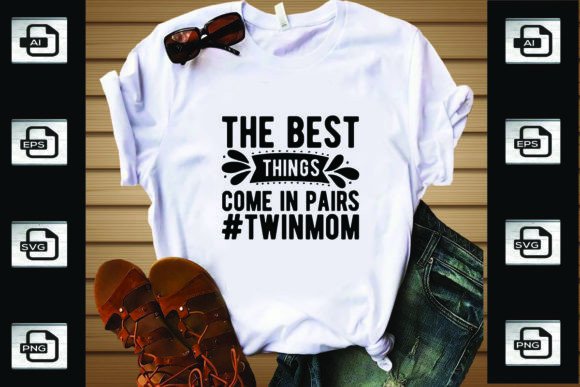
Best Things Come in Pairs: Twin Mom Design Review
As a designer who spends more time behind an embroidery machine than a computer screen, I approach every new graphic with a healthy dose of skepticism. We have all downloaded files that look perfect on a monitor but turn into thread nests or registration nightmares once hooped. When evaluating The Best Things Come in Pairs twin Mom design, my primary concern is not just the cute sentiment, but how those vector shapes will actually translate into stitches on fabric. This review breaks down the practical reality of using this artwork for real-world projects, moving beyond the sales page to discuss stitchability, commercial viability, and production workflow.
First Impressions: Vector Clarity Meets Maternal Sentiment
Upon opening the source files, the immediate advantage of The Best Things Come in Pairs twin Mom is its 100% vector construction. For embroidery digitizers and apparel decorators, this is non-negotiable. Raster images often hide jagged edges that become glaringly obvious when converted to satin stitches. Here, the clean lines suggest that the resulting embroidery file should digitize smoothly without excessive manual node editing. The layout balances typography with graphical elements in a way that feels cohesive rather than cluttered.
The mood strikes a specific chord: celebratory yet grounded. It avoids the overly cursive, hard-to-read fonts that plague many mom-centric designs. Instead, it offers legibility at various sizes, which is crucial when adapting a single machine embroidery design for everything from adult sweatshirts to baby onesies. As a T-Shirt Design, it has strong shelf appeal, but as an embroidery asset, its true value lies in its structural integrity. The separation of elements allows for easy color blocking, meaning you can swap thread colors to match school spirit wear or boutique branding without redesigning the entire piece.
Real-World Application: Stitching a Custom Sweatshirt
To truly judge this asset, I mentally walked through a recent client project: a custom fleece sweatshirt order for a twin mom expecting her first holiday photoshoot. Fleece is unforgiving; texture eats fine detail. Using The Best Things Come in Pairs twin Mom, I assessed how the design would perform on this high-pile fabric.
Because the graphics are resizable vectors, I was able to scale the design up for a chest placement without pixelation. In a real stitching scenario, this scalability allows you to adjust the hoop size appropriately. For the sweatshirt, I would recommend converting thinner text elements into fill stitches or thicker satins to prevent them from sinking into the fleece. The design’s bold nature supports this modification well. If you were creating a matching tote bag design in canvas, the same file could be scaled down slightly, utilizing tighter stitch density since the fabric is stable and flat.
This versatility is what makes it a valuable addition to any craft business inventory. You aren't buying a single-use image; you are acquiring a flexible template that adapts to the substrate. Whether you are producing custom apparel for an Etsy shop or making a personalized gift for a friend, the design holds its visual weight across different mediums.
Navigating Fabric Challenges and Technical Limits
No design is bulletproof, and The Best Things Come in Pairs twin Mom requires thoughtful application depending on your material. While the vector art is crisp, your output depends entirely on stabilization and fabric choice.
- Stretchy Knits and Ribbing: If applying this to a stretchy ribbed knit or performance wear, the horizontal span of the text may distort during stitching. Always use a cut-away stabilizer and consider adding a topping to keep the letters crisp. Test the thread colors against the fabric first, as the contrast needs to be sharp for the "pairs" concept to read clearly from a distance.
- Curved Surfaces: When adapting this for caps or curved sleeves, the linear arrangement of the text may require warping. Because you receive editable formats like AI and EPS, you can gently arc the text in your vector software before digitizing to accommodate the curve, preventing the dreaded straight-line-on-curved-surface look.
- Small Hoop Sizes: Caution is needed when shrinking this design for baby embroidery or sleeve cuffs. Intricate details in the "pairs" iconography may merge if reduced below a certain threshold. Always verify the minimum safe size for your specific machine and needle type. If the lettering becomes too small for standard thread, consider simplifying the design or switching to a micro-thread setup.
- Dark Fabrics: On black or navy garments, ensure your digitizing includes adequate underlay. Light thread on dark fabric requires a solid foundation to prevent the fabric color from bleeding through the stitches. The provided PNG mockup is useful here for previewing contrast before committing to a stitch-out.
Commercial Viability for Sellers and Makers
For Etsy sellers and small shop owners, time is money. The Best Things Come in Pairs twin Mom streamlines the pre-production phase. The inclusion of high-quality 300 DPI PNGs means you can create professional printable mockups instantly for your listings without having to stitch a sample first. This accelerates the listing process and helps validate market interest before you invest hours in digitizing and test stitching.
However, professionalism extends beyond mockups. When selling a finished product, consistency builds trust. Using a high-quality vector base ensures that the tenth sweatshirt you embroider looks identical to the first. For those selling digital embroidery files, providing customers with a design derived from clean vectors reduces support tickets regarding jagged edges or resizing errors. Just remember to double-check your licensing terms regarding commercial use and digital resale to protect your business.
Essential Designer Notes Before You Hoop
Before running The Best Things Come in Pairs twin Mom on a final garment, adhere to these professional best practices:
- Always Test Stitch: Never assume a digital file is perfect for your specific machine-fabric combination. Run a test on scrap fabric that matches your final project’s weight and texture.
- Check Stitch Density: Vectors define shape, not stitch count. Your digitizing software settings determine density. Adjust based on whether you are doing satin stitch borders or fill stitch interiors to avoid puckering on lightweight fabrics.
- Validate Color Contrast: Print the PDF or view the PNG in grayscale. If the design lacks definition in black and white, it will likely lack definition in tone-on-tone embroidery. High contrast ensures readability.
- Confirm File Compatibility: You receive AI, EPS, SVG, PDF, and PNG formats. These are excellent for editing and printing, but they are not native embroidery formats (like DST, PES, or JEF). Ensure you have the software to convert these vectors into stitches, or hire a professional digitizer if you lack this capability.
- Review Licensing: Before listing any commercial embroidery products or modified digital assets, verify the specific usage rights included with your purchase. Protecting your shop starts with respecting intellectual property.
Ultimately, The Best Things Come in Pairs twin Mom is a robust starting point for makers who understand the translation from screen to stitch. Its vector foundation offers the flexibility needed for diverse applications, from nursery decor to adult fashion. By approaching this design with technical mindfulness and proper testing protocols, you can transform a digital graphic into a high-value, tangible product that resonates with customers and stands up to the rigors of real-life wear. Success in embroidery isn't just about the art; it's about the execution, and this asset gives you the right tools to execute well.